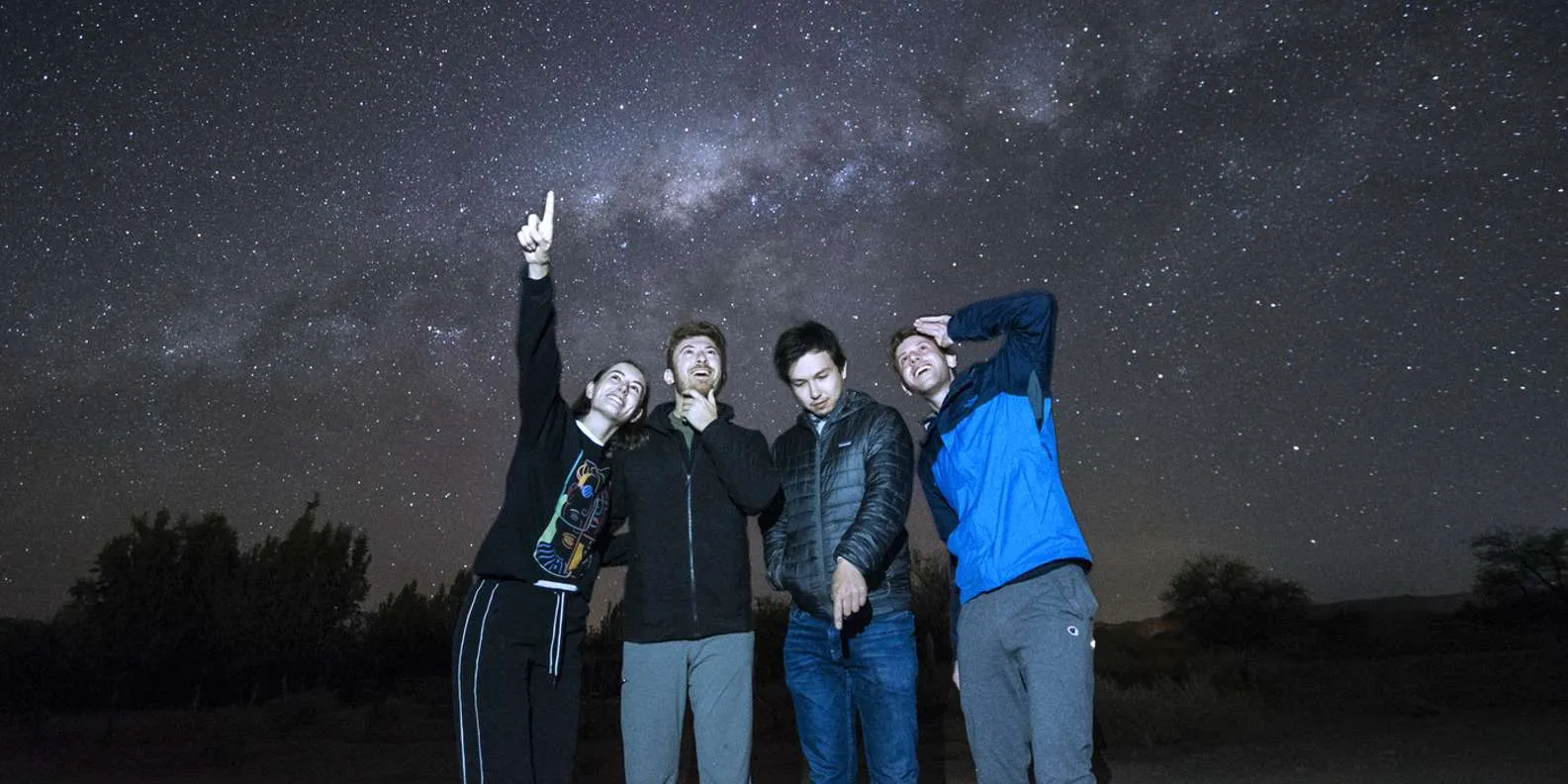
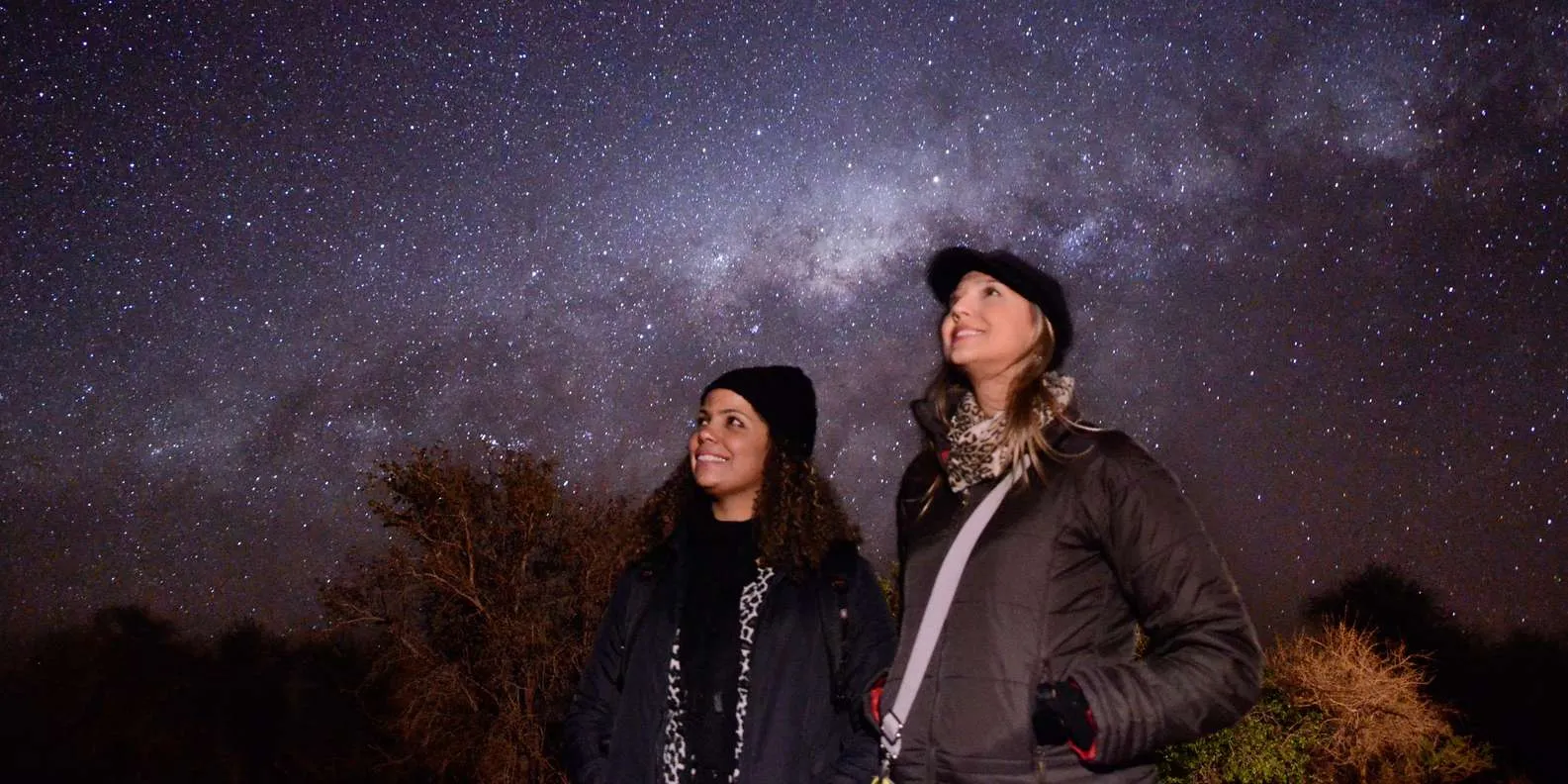
Which astronomy experience suits you?
The Llama Stargazing Experience (4.7/5 from 814 reviews) is a broad introduction with naked-eye observation, telescopes, a photograph, refreshments and blankets. The Stargazing & Andean Astronomy with Wine (4.7/5 from 798 reviews) option adds a distinct cultural perspective, explaining how Andean communities interpreted the Milky Way, including its dark shapes. Our breakdowns of the Llama session and the Andean astronomy session cover pickup, inclusions and restrictions.
Both are advertised at roughly two and a half hours. Neither should be mistaken for a visit to a professional research telescope or the ALMA observatory. It is an outdoor visitor experience at an observing site outside town.
| Your priority |
Start with |
What to verify |
| General introduction and photos |
Llama Stargazing |
Language, pickup option and photo delivery |
| Andean sky interpretation |
Andean Astronomy |
Current format and guiding language |
| Faint stars or Milky Way |
A dark session on either product |
Moon rise/set, cloud and observing time |
| Accessibility |
Ask the Andean Astronomy provider |
Vehicle access and the actual ground surface |
Other experiences you might enjoy
For your days, compare trips to Valle de la Luna, the El Tatio geysers, Piedras Rojas and floating at Laguna Cejar.
Why the Atacama sky is so clear
The short answer: extreme dryness, high altitude, stable air, very little light pollution and a southern-hemisphere view of the Milky Way’s brightest parts.
| Fact |
Answer |
| Altitude of San Pedro de Atacama |
About 2,400 m (7,900 ft) |
| Typical tour length |
2–3 hours, plus a 10–30 minute transfer |
| Best months |
April to October; Milky Way core best placed June to August |
| Riskiest months |
February and March (Altiplanic winter cloud and storms) |
| Moon |
Book within about a week either side of new moon |
| Night temperature |
Coldest from June to August, when it can drop below freezing; milder in summer |
| Minimum age |
From about 4 to 7, depending on the operator |
| Professional observatories |
ALMA (free; regular visits suspended, occasional open days) · Paranal (free Saturday daytime tours, about 2 hours from Antofagasta) |
- Dryness. The Andes rain shadow, the cold Humboldt Current and a semi-permanent high-pressure system keep rain away. Water vapour blurs and absorbs starlight. Climate averages for San Pedro put relative humidity at about 16% in July, rising to about 40% in February.
- Altitude. San Pedro is at about 2,400 m, and the observing sites sit at similar heights. With less atmosphere above you, the views are crisper and steadier.
- Clear nights. Operators and travel media often cite “300+” clear nights a year, and some claim 330–340. No primary meteorological source gives an exact figure, so treat “around 300” as a rough guide.
- Low light pollution. San Pedro is a small oasis town. According to Chile’s Ministry of the Environment, the D.S. N°1/2022 light-pollution standard came into force on 19 October 2024 in astronomical areas, which include San Pedro de Atacama as a commune within 100 km of an observatory site. That means stricter rules on light colour, direction and timing. New lighting elsewhere in Chile must comply from 19 October 2026, and existing lights in the astronomical communes have until 19 October 2029.
- The southern sky. Highlights include:
- the Milky Way’s galactic core in Sagittarius and Scorpius
- the Large and Small Magellanic Clouds, two satellite galaxies of the Milky Way visible to the naked eye
- the Southern Cross and the “pointer” stars Alpha and Beta Centauri
- Omega Centauri, the Milky Way’s largest globular cluster
- the Eta Carinae / Carina Nebula complex, the Jewel Box cluster and 47 Tucanae
- the Coalsack dark nebula
- planets such as Saturn and Jupiter when they are up
The Atacameño (Likan Antai) sky tradition also reads the dark dust lanes of the Milky Way as figures, such as the llama (Yakana). You only see these “dark constellations” under very dark skies.
The professional observatories nearby
| Observatory |
What it is |
Can you visit? |
| ALMA (Chajnantor, about 5,000 m; support facility at about 2,900 m) |
66-antenna radio array, about 35–50 km from San Pedro |
Free daytime visits to the Operations Support Facility only, never the 5,000 m plateau. ESO lists regular weekend visits as not currently possible, and Chile’s tourism board calls them suspended. ALMA has run occasional special open days, including in October 2026; check its website. |
| Paranal / VLT (2,635 m) |
ESO’s flagship optical observatory |
Free Saturday tours at 10:00 and 14:00, booked online. You need your own transport, about 2 hours from Antofagasta and a long day from San Pedro. Reservations open in seasonal blocks. |
| ELT (Cerro Armazones) |
The 39 m Extremely Large Telescope, under construction |
Not open. ESO plans telescope first light for March 2029 and scientific first light for December 2030. |
No tourist tour lets you look through ALMA, the VLT or any professional research telescope: these instruments carry cameras and spectrographs, not eyepieces. Your telescope views come from the tour operators’ own amateur telescopes.
Threats to the dark skies (status in October 2026)
- The AES Andes INNA project has been cancelled. AES Andes announced on 23 January 2026 that it would discontinue the green hydrogen and ammonia megaproject, which covered more than 3,000 hectares 5–11 km from Paranal. On 6 February 2026 the company asked Chile’s Environmental Assessment Service (SEA) to withdraw INNA from evaluation, and ESO’s 9 February update said this “formally confirms that the project is not going ahead.”
- ESO’s March 2025 technical study, led by its Director of Operations Andreas Kaufer, had found that INNA would raise light pollution by at least 35% above the VLT, at least 55% over the CTAO-South site 5 km away and at least 5% over the ELT. ESO described the risk as “severe, irreversible damage” and says the case shows “the urgent need to establish clear protection measures in the areas around astronomical observatories.” AES has not said whether the project could be relocated.
- Satellite constellations such as Starlink streak across long-exposure photos. SPACE’s founder, the astronomer Alain Maury, has written about this.
Stargazing tour types compared
| Tour type |
Who it suits |
Trade-offs |
Our pick |
| Big-telescope group tour |
Anyone who wants the deepest telescope views |
Groups of up to 16, more queuing, more lecture |
SPACE, booked on its own website |
| Small-group tour with photos, wine and a campfire |
Couples and first-timers |
Telescopes are usually smaller (often about 14-inch); quality varies by guide |
Llama Stargazing Experience (4.7/5 from 814 reviews) |
| Andean astronomy |
Travellers curious about local culture |
Science depth varies; ask how much is Andean and how much is standard astronomy |
Stargazing & Andean Astronomy with Wine (4.7/5 from 798 reviews) |
| Private tour |
Proposals, families, photographers |
Expensive, but on your schedule |
Bajo la Noche de Atacama’s private group, from CLP 250,000 on its own website (checked October 2026) |
| Lodge observatory |
Guests at Explora or Nayara Alto Atacama |
Only for guests; formats vary |
Included in those lodges’ all-inclusive stays |
Budget sessions sold by agencies on Caracoles street tend to have bigger groups, smaller telescopes and more generic guiding. Among the bookable listings, the Llama session is the lower-cost group option.
Operators compared
Prices change often and differ between an operator’s own website and resellers, so check the price on the day you book. The figures below were checked in October 2026.
| Operator |
Price |
Group size |
Telescopes and extras |
Moon policy |
Where to book |
| SPACE (San Pedro de Atacama Celestial Explorations), founded in 2003 by the astronomer Alain Maury |
CLP 45,000 for the general tour on its own website |
Up to 16 |
60 cm and 72 cm telescopes plus a 1.15 m reflector, which SPACE describes as the largest telescope open to the public in the southern hemisphere; hot drink; souvenir photo. English, French and Spanish. Site about 15 minutes from town; meet at the E26 school |
No tours on the 7 nights around the full moon |
SPACE Star Tours, online only, often weeks ahead. Private and “bucket list” sessions for experienced amateurs (not June–August); telescope rental |
| Bajo la Noche de Atacama (guide Rodrigo Zúñiga) |
CLP 35,000 on its own website; Astronomical Tour “Under the Night Sky”, from US$61, 4.9/5 from 334 reviews on Viator |
2–16 |
Electronic telescopes, laser sky tour, astrophoto portrait, wine and snacks by a campfire; Cúcuter site about 8 km south |
Runs up to 70% lunar illumination; occasional “Astrolunar” tour |
Own website or Viator. Refund or new date if cancelled for cloud |
| The Roofless Experience (guide Jhonatan Campano) |
The Roofless Experience: Premium stargazing, from US$65, 4.9/5 from 579 reviews on Viator |
Up to 12 |
Two 14-inch telescopes, professional Milky Way portrait, wine and snacks |
Runs; reviewers advise a moonless date |
Viator; some departures English-only with a 9 p.m. start |
| Astrotour Chile |
Astrotour Chile: Astronomical Tour and Astrophoto, from US$48, 4.5/5 from 187 reviews on Viator |
Up to 14 |
Own observatory 6 km south; astrophoto portrait; snacks and drinks; blankets; a bathroom; Spanish, English, French and Portuguese |
Runs at full moon (no astrophoto then) |
Own website or Viator. Under-4s not allowed |
| Llama Stargazing |
See the tour card above |
Up to 16 |
Wine or pisco sour, astrophotos, snacks, blankets; no bathroom. The operator says its guide has an astronomy PhD |
Discounted “Full Moon Week” tour focused on the Moon |
Llama Stargazing Experience on GetYourGuide (4.7/5 from 814 reviews); meet at the E-26 school |
| Ahlarkapin Observatory, run by Atacameño locals |
By quote |
Groups of 4–14 (third-party listing) |
Andean and scientific astronomy, projector talk, aperitif |
“Discovering Mother Moon” and full-moon night walks |
Ahlarkapin by email or WhatsApp, or through agencies |
| Explora Atacama and Nayara Alto Atacama |
Included in the stay |
Lodge guests |
Onsite observatories; Nayara’s “Ckepi” observatory has a 16-inch telescope (per Lonely Planet) in the Catarpe Valley, darker than town |
Varies |
Lodge guests only |
Our picks by type of traveller
- Best telescope views: SPACE. No other San Pedro tour comes close on aperture, and its 1.15 m reflector shows galaxies and nebulae as more than grey smudges. Book weeks ahead on its website; there is no phone line. Recent reviews mention crowding at the eyepieces (one July 2025 reviewer counted “20 people for 3 telescopes”) and poor communication about cloud cancellations. Expect a lot of lecture.
- Best small-group all-rounder: Bajo la Noche de Atacama. At CLP 35,000 on its own site it is good value. It says plainly that it stops at 70% moon illumination, offers a refund or new date for cloud, and includes astrophoto portraits and a campfire. Its founder appeared as the local astronomer in a National Geographic piece on Chilean stargazing. Book through Viator (4.9/5 from 334 reviews) or its own website.
- Best for photos and atmosphere: The Roofless Experience. A 12-person cap, professional Milky Way portraits, wine and a consistently high rating make it the couple’s pick, at a higher price: from US$65 on Viator (4.9/5 from 579 reviews).
- Best for comfort and families: Astrotour Chile. It has a bathroom on site, which is rare, plus blankets, four languages, a 14-person cap and a clear child policy: from US$48 on Viator (4.5/5 from 187 reviews).
- Best lower-cost group session: Llama Stargazing. The Llama Stargazing Experience has 814 reviews at 4.7/5. If moonlit dates are your only option, its discounted Full Moon Week tour is a reasonable way to go.
- Best cultural sessions: the Andean Astronomy tour with wine, or Ahlarkapin, an observatory run by Atacameño people that combines Andean and scientific astronomy; ask it for a quote.
- Best luxury: stargazing from your own lodge’s observatory at Explora Atacama or Nayara Alto Atacama, with no transfer.
- Best for serious amateur astronomers: SPACE’s “bucket list” session or telescope rental, with hours at the 1.15 m telescope and a night in its lodge.
Eight questions to ask before you book
- What is the biggest telescope, and how many telescopes are there per guest? Aperture matters for deep-sky objects. Divide the group size by the number of telescopes.
- What is the maximum group size? 12–16 is good; 20 or more means queues.
- What is the moon policy? Does the tour run at full moon, at a discount, or not at all?
- What happens if it is cloudy or windy? Look for a refund or new date, and ask how you will be told.
- Is the tour in your language, or “bilingual”, meaning split attention?
- Is hotel pickup included? Many tours skip the outlying ayllus (Cúcuter, Tulor, Coyo, Solor, Quitor).
- Is there a bathroom, and are blankets provided?
- Are astrophotos included, and how many?
Moonlight changes the experience
A dark sky helps reveal faint celestial objects, while a bright Moon can be a worthwhile telescope target in its own right. “Clear sky” and “dark sky” are different things. Read the operator’s explanation of what they observe on moonlit dates before booking a tour for a particular photograph.
SPACE, a separate local astronomy specialist, does not run tours on the 7 nights around the full moon. That is SPACE’s own policy, and other operators still run on those nights. Bajo la Noche stops at 70% illumination, and others run “moon tours” focused on the Moon and planets. The featured Llama listing explicitly offers stargazing or Moon-and-planets formats. Our best-time guide includes a date checker to help you ask the right question; it does not replace a weather forecast or operator confirmation.
As a rule of thumb, aim for the week either side of new moon. If you have to go near full moon, choose an early session before moonrise in the waning phase. For example, SPACE’s moon table lists the full moon on 26 October 2026 and the new moon on 9 November 2026.
Best months for stargazing
| Months |
Sky conditions |
Night temperature in San Pedro |
Verdict |
| December–January |
Often clear, though the Altiplanic winter (December–March) can bring cloud; late sunsets, so tours start around 21:00 |
Mildest of the year, still cool after dark |
Good, in peak tourist season |
| February–March |
The rest of the Altiplanic winter: afternoon storms and cloud, and the highest cancellation risk |
Mild, still cool after dark |
Riskiest; keep spare nights |
| April–May |
Drying out and clear; the Milky Way core rises earlier |
Cool, and colder each week |
Excellent |
| June–August |
Driest and clearest; galactic core high in the early evening |
The coldest; it can drop below freezing |
Best skies, coldest nights |
| September–November |
Clear; the core sinks west after dusk |
Cold, easing towards summer |
Very good |
The moon phase matters more than the month: a full moon washes out the Milky Way and faint objects in any season.
What happens during the session
On the Llama product, the described journey is about 15 minutes out of the centre. The session begins with an explanation of the sky visible to the naked eye and continues at the telescopes. The objects available change with the season and conditions. A listing mentioning galaxies and planets is describing possibilities, not promising every object on every departure.
Tours start around 19:00–20:00 in winter and around 21:00 in summer, and finish 2–3 hours later. Some groups, and SPACE’s specialist sessions, run past midnight.
The photograph is a souvenir of the experience. It does not mean the naked-eye view will look like a long-exposure image, and it is not automatically a dedicated astrophotography lesson. If you want to bring your own camera and tripod, ask about time, space and assistance before reserving.
Pickup, drop-off and late-night transport
Llama lists School E26 as a meeting point for an option, with hotel return coverage near the centre. It excludes several outlying ayllus from its return driving. The Andean Astronomy product also says the meeting arrangement varies by option. Select the transport option deliberately; the words “pickup available” are not a promise that every booking includes it.
This matters when choosing accommodation. A quiet property outside town may need its own late-night transfer. Confirm that arrangement before paying, so you do not discover the gap after a midnight return.
Plan for standing in the cold
Take warm layers and closed shoes even if the afternoon felt hot. Winter nights in San Pedro can drop below freezing. Blankets or ponchos and hot drinks are useful extras, not a replacement for appropriate clothing. Ask about toilets and access if those will determine whether the tour works for your group.
Try for an early evening in your stay, leaving another night as a possible weather alternative. One reviewer’s first-choice tour was cancelled four nights in a row because of wind. Do not assume a weather cancellation guarantees space tomorrow. Avoid pairing a very late session with the El Tatio predawn departure: a few hours in bed makes an already demanding morning harder.
What to pack
- A down or insulated jacket (essential from April to October), plus a warm hat and gloves
- A thermal base layer, warm socks and closed shoes for uneven ground
- A red-light headlamp, or red film over a torch
- A phone with night mode, a small tripod or phone clamp, and a power bank (batteries drain in the cold)
- Cash in Chilean pesos for site fees and tips
- Water, lip balm and moisturiser for the very dry air
- Optional: binoculars (7x50 or 10x50 show the Magellanic Clouds and star clusters well)
See the full packing list for the rest of the trip.
Children, booking and payment
- Altitude. At about 2,400 m the tour itself asks little of you physically. If you have just arrived from sea level, take it easy, drink water and limit alcohol on the first night; the altitude guide has more.
- Children. Age rules vary by operator:
- The Llama listing excludes under-4s.
- Astrotour Chile does not allow under-4s.
- Bajo la Noche’s Viator listing is for ages 5–99.
- GreatChile, which resells SPACE, sets a minimum age of 7, while SPACE itself accepts children who do not disturb the group or touch the telescopes.
- Accessibility. Observing sites are open desert with uneven ground, and they are dark (red lights only). Few have proper bathrooms. Contact the operator about mobility needs; private tours are the most flexible.
- Booking ahead. Book at least a few days ahead in normal months, and 1–3 weeks ahead in July and over the December–January holidays. SPACE says it often books up weeks ahead and turns away 10–20 people a night.
- Cancellations. GetYourGuide and Viator listings usually offer free cancellation up to 24 hours before. Direct and agency terms vary: GreatChile, for example, refunds 90% if you cancel 3 or more days ahead and nothing within 2 days.
- Payment. SPACE accepts card, Chilean pesos, US dollars or euros. Some observing sites charge a cash site fee, so carry pesos.
- Tipping. Tips are not included on most tours. CLP 3,000–5,000 per person for a great guide is a reasonable amount; this is our suggestion, not an official standard.
- Red-light etiquette. No white torches or phone screens at full brightness. Use red mode, and never point lasers or lights at the telescopes or at people.
- Language. English tours are widely available. One GetYourGuide reviewer said Spanish speakers got more time in a split group, so ask whether your session is English-only or shared.
Taking photos of the night sky
- Phone: use night or astro mode on a tripod and expect 10–30 second captures. Many tours include a professional portrait, which is easier than doing it yourself.
- Camera starting settings: a wide lens (14–24 mm) at f/2.8 or wider, ISO 3200–6400, a 15–20 second exposure and manual focus on a bright star.
- Through the telescope: many guides will hold your phone to the eyepiece for Moon shots. Astrotour does not offer astrophotography at full moon.
- Avoid the full moon for Milky Way photos.
Stargazing without a tour
You can, with limits. A great sky starts a few minutes’ walk or drive beyond the town lights. Valle de la Luna is not a night option: it is a ticketed reserve open from 8:00 or 9:00 until 16:00 or 17:00 depending on the season, and general entry was CLP 10,800 when we checked in October 2026. See our Moon Valley guide for daytime visits.
Do not wander onto private ayllu land or into ravines in the dark. Drive slowly on the unlit roads, watch for animals, go in company, tell someone where you are going and carry warm layers. A tour adds what a walk cannot: telescopes, a guide to find objects, and photographs.
Combining stargazing with other tours
- A Valle de la Luna sunset and stargazing make a classic same-day pairing. Leave a short break to eat and collect your layers.
- El Tatio. Geyser pickups are around 4:00–5:00 a.m. SPACE advises against doing the geysers and a late astronomy tour on the same day, or a tour the night before the geysers.
- A four-night plan:
- ALMA: when the free support-facility visits run, they are on weekend mornings. Book through ALMA directly; no agency can sell you ALMA access.
The three-day itinerary and the full tour comparison show where a night tour fits around the day trips.
Other stargazing destinations in Chile
- Elqui Valley (Coquimbo region): home of the Gabriela Mistral Dark Sky Sanctuary, which covers the AURA Observatory site. The International Dark-Sky Association announced it on 9 August 2015 as the world’s first International Dark Sky Sanctuary. Mamalluca Observatory near Vicuña was Chile’s first tourist observatory and runs English tours of about 1.5 hours, with transport extra.
- Paranal (VLT): free Saturday daytime tours, best combined with a stay in Antofagasta, not San Pedro.
- How they compare: San Pedro offers higher altitude, drier air and more operator choice. Elqui is easier to reach from Santiago and has more established observatories and astro-hotels.
Common complaints, and how to avoid them
- “Too many people per telescope.” Ask for the group cap and the number of telescopes.
- “Endless lecture, 10 minutes at the eyepiece.” One September 2025 TripAdvisor review of a “Space Star Tours” session described “3 hours and 50 minutes standing in the cold” with about 10 minutes at the telescopes. Pick a format that suits you.
- “Cancelled with no notice” or “we waited at the meeting point”. Confirm a WhatsApp contact.
- “We waited an hour before leaving.” Pickups can run late.
- “The full moon ruined it.” Check the lunar calendar before you book.
Source for SPACE’s full-moon policy, group size and price: SPACE Star Tours, checked October 2026.