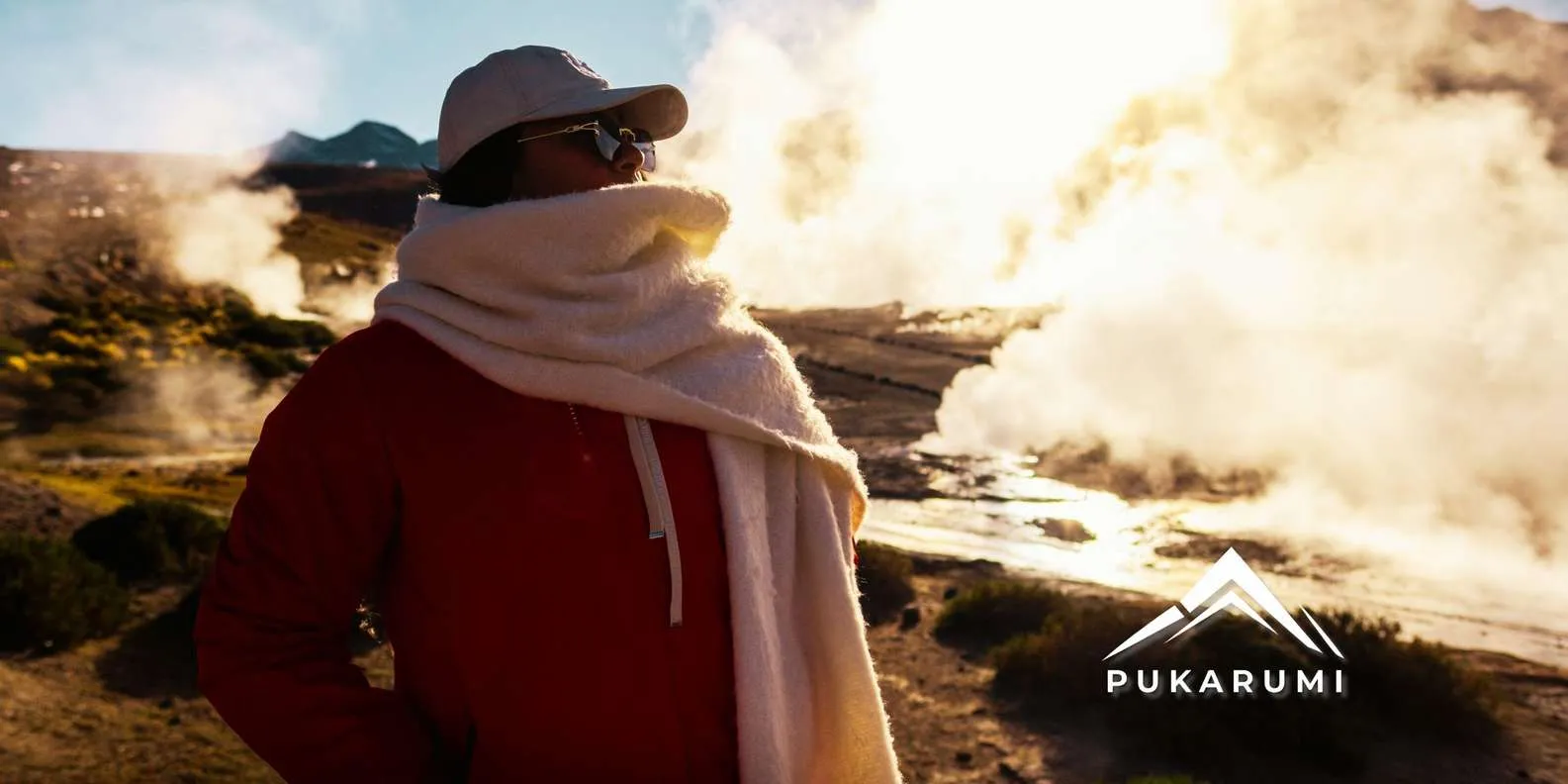
Is El Tatio worth the early start?
Choose El Tatio when the geothermal landscape is a priority and you are comfortable with a cold, very early morning. The featured six-hour trip combines the geyser field, breakfast and Andean wildlife scenery. It is a different outing from the Piedras Rojas circuit: here the main event is sunrise steam, where Piedras Rojas is a whole day moving between lagoons.
We feature the Pukarumi sunrise-and-breakfast listing because it has substantial product-specific review history and clearly states its pickup and admission arrangements. It is not the right choice for everyone: the current restrictions are tighter than on some other desert excursions.
El Tatio at a glance
|
|
| Where |
In the Andes north of San Pedro de Atacama, near the Bolivian border |
| Getting there |
About 90 km and 1.5 hours by road from San Pedro, according to the El Tatio site |
| Altitude |
Above 4,300 m; San Pedro sits at about 2,400 m |
| What you see |
More than 80 geysers plus fumaroles, hot springs and mud pots; a 2003 study by Glennon and Pfaff calls it the largest geyser field in the southern hemisphere and the third largest in the world |
| Best time of day |
Around sunrise, when the cold air turns the vapour into thick white columns |
| Opening hours |
06:00–16:00 |
| Entry |
CLP 15,000 from age 9; CLP 5,000 for Indigenous visitors with a CONADI certificate; free with a disability credential |
| Payment |
Card or bank transfer, per the El Tatio fee page; carry the cash amount as a backup |
| Not admitted |
Children aged 0 to 8 and pregnant visitors; the park does not recommend the visit for people over 70 |
| Thermal pool |
Not open (“no habilitada”) |
| Managed by |
The Atacameño communities of Caspana and Toconce, who have co-administered the site since 2006 |
| Featured tour |
Tatio Geysers at Sunrise, Breakfast & Incredible Landscapes (from US$73, 4.7/5 from 1,151 reviews) |
The figures above come from the El Tatio fee and visitor pages, which the communities run; check them again a few days before you go, because fees and rules can change.
Other experiences you might enjoy
On the days around your sunrise trip, compare Valle de la Luna at sunset, the Altiplanic lagoons and Piedras Rojas, floating at Laguna Cejar and a stargazing session on another night.
What El Tatio is
El Tatio is a geothermal field at the foot of the volcanoes along the Chile–Bolivia border. Rain and snowmelt seep into the ground, are heated at depth and come back to the surface as boiling springs, steam vents and small geysers. Counts vary between surveys because individual geysers switch on and off over the years.
The eruptions are small. Most rise well under a metre, with occasional jets of a few metres, so you go for the field of steam at dawn and not one big gusher. The steam is at its thickest early because the vents release much the same heat all day: in freezing, dry air the vapour condenses straight into white plumes, and once the sun warms the air the columns thin out. That is why every tour leaves San Pedro in the dark.
Scientists use the field too. In 2016 Steven Ruff and Jack Farmer of Arizona State University reported in Nature Communications that El Tatio’s silica deposits closely match those found by NASA’s Spirit rover on Mars. The same springs carry arsenic into the Río Salado, one more reason never to touch or drink the water.
History and who runs it
An Inca trail between San Pedro and Bolivia crossed the field. Geothermal prospecting began in the 1920s, and in 2008 a consortium led by Italy’s Enel and Chile’s state oil company ENAP started exploratory drilling a few kilometres from the geysers. In September 2009 an old well blew out and sent a column of steam about 60 metres high into the air for weeks; regional authorities halted the project.
Today the site is run by a company formed by the Atacameño (Lickanantay) communities of Caspana and Toconce, and your entry fee goes to it. Many tours stop on the way back at Machuca, a small hamlet of adobe houses with a small church.
A realistic morning sequence
Before departure: prepare your warmest layers the night before, check the operator’s message and keep your phone available. The listing gives a pickup window around 04:30–05:10, with the precise time confirmed before the tour. Be ready at the agreed location, and do not assume the van will call from a distant meeting point.
At the geysers: stay on the designated paths and follow the guide’s instructions. The geothermal field is an active environment, not somewhere to wander towards steam for a closer photograph. Cold, wind and the altitude affect how comfortable you feel standing still.
After sunrise: breakfast and the changing mountain scenery are part of the outing. Wildlife may be seen, but neither species nor sightings are guaranteed. Ask the operator for the current return time: the listing’s return text contains an obvious AM/PM inconsistency, so do not plan a flight connection around it.
A typical shared tour, hour by hour
Times vary by operator and season; this is the usual order on a shared sunrise tour.
| Time (approx.) |
What happens |
| 04:30–05:10 |
Hotel pickup in urban San Pedro |
| 05:00–06:30 |
The drive north in the dark, climbing about 1,800 m; many people sleep |
| 06:00–06:45 |
Arrival, entry payment or check, toilets |
| 06:30–08:00 |
Guided walk on the marked paths as the sun rises, with the thickest steam |
| Around 08:00 |
Breakfast by the vans: hot drinks, bread, cheese and ham on most tours |
| Later morning |
The return drive, with stops at the Putana river wetland for birds and vicuñas, and at Machuca village, where snacks are sold for cash |
| Late morning to midday |
Drop-off in San Pedro |
What the reservation covers
The tour includes the bilingual guide, central hotel pickup and breakfast. El Tatio admission is extra and the listing requests payment in advance at the agency. Confirm the amount and whether payment must be cash before the evening preceding departure.
Pickup is restricted to urban San Pedro. The listing excludes nearby ayllus including Quitor, Yaye, Checar, Sequitor, Solor and Coyo, as well as Toconao. If you choose a quiet outlying hotel, arrange how to reach the meeting point at that hour before paying for the tour.
Our breakdown of the El Tatio sunrise tour lists every inclusion, exclusion and restriction on the listing.
Ways to visit El Tatio
The shared tour is the one most visitors take, and the featured listing has by far the longest review history of the three. The private tour from Molantur includes park entry and a breakfast stop at Geyser Blanco; book it if you want to set your own pace and can pay several times the shared price. The four-tours-in-three-days package suits a short stay if its order gives you time to adjust before the geysers.
If you want a hot soak the same day, book a Puritama afternoon entry separately on the Puritama site and see our Puritama guide. The pool at El Tatio itself is not open.
How to choose an El Tatio operator
- Oxygen on board. Ask whether the vehicle carries oxygen and a pulse oximeter.
- Group size. Ten to twelve people is comfortable; fifteen or more feels like a bus tour.
- A heated vehicle. You spend close to two hours each way in the dark and cold.
- Breakfast. Recent reviews tell you whether the hot drinks and food arrive warm.
- Departure time. Vans that leave at the start of the 04:30–05:10 window usually reach the field before the busiest moment.
- Registration. Chile’s tourism service, Sernatur, keeps a register of tourism providers; ask whether your operator is on it.
- The entry fee. Make sure the booking says whether the CLP 15,000 is included and how you pay it.
Park rules and safety
The ground near the vents is a thin crust over scalding water. Stay inside the marked paths, where small stones mark the edges, and never step towards a vent for a closer photograph. Do not touch the water or the fumaroles.
These rules matter. In October 2015 a Belgian visitor in her late sixties fell backwards into a geyser while taking a photograph and died of her burns, Reuters reported. Stop walking before you raise a camera, and expect glasses and lenses to fog in the steam.
Other rules for visitors: no smoking, no feeding the wildlife and no drones without authorisation. Use the toilets at the entrance and in the main area. If you drive yourself, park in the area for private vehicles.
Is the thermal pool open?
No. The El Tatio fee page lists the geothermal pool as “no habilitada”, which means it is not open for bathing. Older guides and some listings still mention a swim, so ask your operator directly before you pack a swimsuit. If soaking matters, plan an afternoon at Puritama instead.
Facilities
Expect a ticket office, parking, toilets and marked trails across the main geyser areas, but no café. Bring water and a snack, or rely on the tour breakfast.
Driving to El Tatio yourself
You can visit without a tour. The El Tatio site publishes rules for independent visitors, who pay at the entrance and park in their own area.
- Route and time: the El Tatio site gives about 90 km and 1.5 hours from San Pedro. Slower vehicles take longer.
- Vehicle: the site recommends a 4x4 because of the road. Expect gravel and washboard sections, and conditions get worse quickly after snow or summer storms.
- In the dark: you share the road with dozens of tour vans. Drive slowly, watch for vicuñas and ice, and never overtake without a clear view.
- Fuel and signal: fill up in San Pedro, as there are no services on the way, and download offline maps, as there is no phone signal.
- Timing: arrive about half an hour before sunrise for the thickest steam. For fewer people, arrive after the vans start leaving, around 08:30, and accept thinner steam.
Check the road and weather before you leave. On 11 August 2026 Carabineros closed Route B-223 at Machuca because of snow, and on 13 August the municipality said El Tatio was still closed while most lower sites had reopened.
Altitude and suitability
El Tatio is above 4,300 metres in the current listing. This is a substantial ascent from San Pedro. Make it one of your later excursions and keep the preceding night quiet. Our altitude guide explains the difference between day-trip and sleeping altitude, warning symptoms and when to reconsider an ascent.
The featured listing excludes children under 9 and adults over 60, along with travellers with specified heart, blood-pressure or altitude problems. Those are the conditions of this product; do not assume that being physically fit overrides them. If the restriction affects your group, seek an operator-confirmed alternative rather than changing an age on the reservation.
The park has its own rules on top of the listing: children aged 0 to 8 are not admitted without exception, pregnant visitors are not admitted, and the visit is not recommended for people over 70. Visitors aged 60 and over are asked to tell staff when they arrive. Drink water the day before, skip alcohol the night before and walk slowly at the field. Tell your guide at once about confusion, severe breathlessness at rest or loss of coordination.
How cold it gets and what to wear
It is below freezing at the geysers at dawn in every season. Expect somewhere around −5 °C to −10 °C, colder on winter mornings, and wind makes it feel worse. By the time you are back in San Pedro it can be T-shirt weather.
The seasons change the trip in different ways. Winter mornings (June to August) are the coldest and give the thickest steam, but snow can close the road. December to March can bring highland storms. The best time to visit guide covers the rest of the year.
Dress in layers you can take off on the drive back:
- a thermal base layer, a fleece and an insulated jacket
- a windproof outer shell
- a hat that covers your ears, warm gloves and a scarf or buff
- wool socks and closed shoes with thick soles; frozen ground is hard on thin trainers
- hand and toe warmers, if you feel the cold
- sunscreen, lip balm and sunglasses, as the sun is strong at this height once it is up
- water, the entry fee and small cash for snacks at Machuca
Leave a drone at home unless you have authorisation. Our packing list covers the rest of the trip.
Photographing the geysers
- Shoot towards the sun once it rises: backlit steam glows.
- Arrive before sunrise for blue-hour shots of the plumes against the volcanoes.
- Put a person in the frame for scale.
- Keep spare batteries inside your jacket, as the cold drains them fast.
- Let your camera warm up in a bag after the heated van, or the lens fogs.
- A wide lens and a phone’s night mode both work; set up a tripod only on the marked path.
- Stop walking before you look at the screen.
How El Tatio compares with other geyser fields
|
El Tatio (Chile) |
Yellowstone (USA) |
Geysir and Strokkur (Iceland) |
Sol de Mañana (Bolivia) |
| Altitude |
Above 4,300 m |
Roughly 2,200–2,400 m |
Near sea level |
Close to 4,900 m |
| What erupts |
Many small geysers and steam vents |
Hundreds of geysers, including tall, predictable ones |
Strokkur erupts every few minutes |
Mostly boiling mud pots and fumaroles |
| Best for |
A sunrise field of steam with Andean scenery |
Big eruptions from boardwalks |
An easy, reliable eruption |
A raw, sulphurous landscape |
| Getting there |
A 04:30 start from San Pedro |
Drive in |
A day trip from Reykjavík |
A dawn stop on the Uyuni crossing |
If you are doing the Uyuni crossing, you pass Sol de Mañana on the Bolivian side. It is higher and wilder but has few true geysers; El Tatio has the better geyser field. With time for both, do both, as they feel very different.
Common complaints, and how to avoid them
| Complaint |
What helps |
| “It was freezing.” |
Proper gloves, warm socks and toe warmers make the biggest difference. |
| “The 04:30 start was brutal.” |
Go to bed early, skip stargazing the night before and sleep in the van. |
| “It was crowded.” |
Choose an operator that leaves early, book a private tour, or arrive after the vans leave. |
| “The geysers were tiny.” |
They are. You go for the steam field and the sunrise. |
| “I felt sick.” |
Go after a couple of lower days in San Pedro, walk slowly and ask for oxygen. |
| “The pool was closed.” |
It is officially closed. Book Puritama for a soak. |
How to fit it into your trip
An afternoon Moon Valley tour may fit after a morning return, but it makes a demanding day. Keep a genuine gap for lunch and rest, and check both suppliers’ times. We prefer to put stargazing on a different night rather than pairing a late return with the predawn pickup.
If you have only two days and have just arrived from low altitude, choose a lower-altitude itinerary instead of forcing El Tatio into it. The geysers are memorable, but you do not need to force them in to have a good Atacama visit, and how you feel matters more than the schedule.
On a four- or five-day stay, day three or four suits El Tatio, with an early dinner the night before and a rest or a Puritama soak the afternoon after. Any central hotel works, since pickup covers urban San Pedro; see where to stay and getting to San Pedro. The three-day and four-day plans show where the geysers fit, and if you have not fixed your dates yet, our guide to the best time to visit shows how the season affects the high-altitude trips.