Choose the endpoint before the price
The selected White & Green Travel product, the 4-Day Uyuni Salt Flats Tour from San Pedro de Atacama (from about US$352, 4.5/5 from 88 reviews), travels from San Pedro through Bolivia’s highlands to Salar de Uyuni, then returns to San Pedro on day four. If you want to continue through Bolivia, a one-way itinerary is a different product and needs its own confirmation. A low headline price does not help if it returns you to the wrong country.
For the one-way crossing, GetYourGuide has no listing from San Pedro. Our pick is the Uyuni salt flat tour on Viator, one way or round trip (from about US$412, 4.4/5 from 46 reviews), run by Uyuni Adventure: you choose three days ending in Uyuni or four days back to Chile, with shared or private rooms and a Spanish or English-speaking driver. We have not used a Bolivia-departure product as if it began in Chile. Confirm the endpoint, luggage arrangement and border transfer before comparing offers.
Quick facts
|
|
| Classic format |
3 days / 2 nights, San Pedro to Uyuni (one way) |
| Other formats |
4 days / 3 nights back to San Pedro; reverse Uyuni to San Pedro (3 days); private 2–4 days |
| Price |
From about US$352 for the four-day return on GetYourGuide; from about US$412 on Viator for the one-way or return listing |
| Cash on top |
Reserve entry, Isla Incahuasi, the Polques hot springs, the Bolivian border charge and toilets, paid in bolivianos; ask for the current amounts |
| Highest point |
Sol de Mañana geothermal field, about 4,900 m |
| Sleeping altitude |
Night 1 roughly 4,000–4,600 m, depending on the lodge; night 2 roughly 3,650–3,700 m |
| Group |
Up to six people in a 4x4 with a Spanish-speaking driver |
| Border |
Hito Cajón (Chile/Bolivia), about 4,480 m |
| From San Pedro to the border |
A short minibus climb up Route CH-27; the Chilean post opens around 08:00 Chilean time |
| Best months |
April–May and September–November (dry and milder); January–March for the mirror effect |
| Bolivia entry |
No tourist visa for US, UK, EU, Canadian or Australian passports; SIGEMIG online registration for everyone |
| Currency |
Boliviano (Bs), floating since late June 2026 |
| Minimum age (typical) |
About 8; some operators ask over-65s for a medical certificate |
Other experiences you might enjoy
Before Bolivia, spend a few days around San Pedro: sunset in Valle de la Luna, dawn at the El Tatio geysers, which double as an altitude test, and stargazing.
Is the crossing worth it?
For many travellers it is one of the highlights of South America, and it is uncomfortable by design. Here is who it suits:
- Book the one-way tour if you are continuing into Bolivia (La Paz, Sucre, Potosí). The tour is your transport, and few border crossings on the continent are this scenic.
- Book the four-day return if you are flying out of Calama. You see the full circuit without having to get back from Uyuni.
- Think twice if you have heart or lung conditions or high blood pressure, or are pregnant. Operators routinely exclude these travellers because the route goes close to 5,000 m.
- Skip the overland route if you only care about the salt flat itself. Fly to Uyuni via La Paz and take a one-day tour instead (see the alternatives below).
The three-day route to Uyuni, day by day
Itineraries vary by operator and season, and many operators move passengers between vehicles to fill each car. This is the most common version.
Day 1: San Pedro, Hito Cajón, the lagoons and Laguna Colorada
- About 06:00–07:30: hotel pickup by minibus in San Pedro (about 2,400 m). Pickups usually cover the town centre, not ayllus such as Quitor, Solor or Coyo.
- Chilean exit: you get your exit stamp from the PDI (Chilean immigration), then the minibus climbs Route CH-27 to the Hito Cajón border post at about 4,480 m. The Chilean side opens around 08:00 Chilean time. Plan on one to three hours of queuing between the two posts.
- Bolivian migration: show your passport and SIGEMIG QR code and pay the border charge. You switch to a Land Cruiser here, and bags go on the roof.
- Eduardo Avaroa reserve gate: pay the entry fee in cash. The reserve covers about 7,150 km², was created in 1973 and lies between about 4,200 m and 5,400 m.
- Laguna Blanca and Laguna Verde (about 4,330 m): a mineral-tinted lagoon below Licancabur volcano (about 5,920 m). It looks greenest when the afternoon wind stirs the water, so a morning visit can look pale.
- Desierto de Dalí: boulders scattered over a pastel desert.
- Termas de Polques (about 4,400 m): natural hot pools at around 29–30 °C. Bring a swimsuit and towel, and cash for the small entry charge.
- Sol de Mañana (about 4,900 m): fumaroles and boiling mud pots at the highest point of the trip. Stay on firm ground and behind your driver, because the crust is thin and the steam scalds.
- Laguna Colorada (4,278 m): a lake of about 60 km² coloured red by algae, with white borax islands and Andean, James’s and Chilean flamingos. The Ramsar Convention site entry for the Los Lípez wetlands counts about a quarter of the world’s Andean flamingos and half of its James’s flamingos.
- Night 1: a basic refuge, commonly in Villa Mar on San Pedro departures. Other operators sleep near Laguna Colorada (Huayllajara) or at upgraded lodges in the Siloli desert at about 4,600 m. Expect shared rooms and bathrooms, cold showers or paid hot ones, and no heating.
Two routes are common, and both are good:
- The lagoon route: Árbol de Piedra, the wind-carved stone tree in the Siloli desert about 18 km north of Laguna Colorada; then the high lagoons Honda, Ch’arkota, Hedionda and Cañapa (all roughly 4,100–4,200 m, with flamingos); the Ollagüe volcano viewpoint (an active volcano of about 5,870 m on the Chilean border); then the villages of San Juan, Villa Alota or Culpina K.
- The canyon route: the Tomás Lakha rock paintings, the Italia Perdida rock city, Laguna Vinto, the Anaconda and Sora canyons, then across the Salar de Chiguana to Colcha K.
- Night 2: a salt hotel on the southern edge of the salt flat (Colcha K, Chuvica, San Juan or Villa Candelaria), with walls and beds made of salt blocks. Many have private bathrooms and hot showers. You sleep at about 3,650–3,700 m, which is easier.
Day 3: sunrise on the Salar de Uyuni, Incahuasi and Uyuni town
- About 04:30–05:30: leave in the dark to watch sunrise on the Salar de Uyuni (about 3,656 m), at roughly 10,500 km² the largest salt flat on Earth.
- Isla Incahuasi: a coral-rock island covered in giant cacti in the middle of the salt flat, with a cash entry fee and a short trail to a viewpoint. It is often unreachable in the wet season, when tours skip it or substitute another stop.
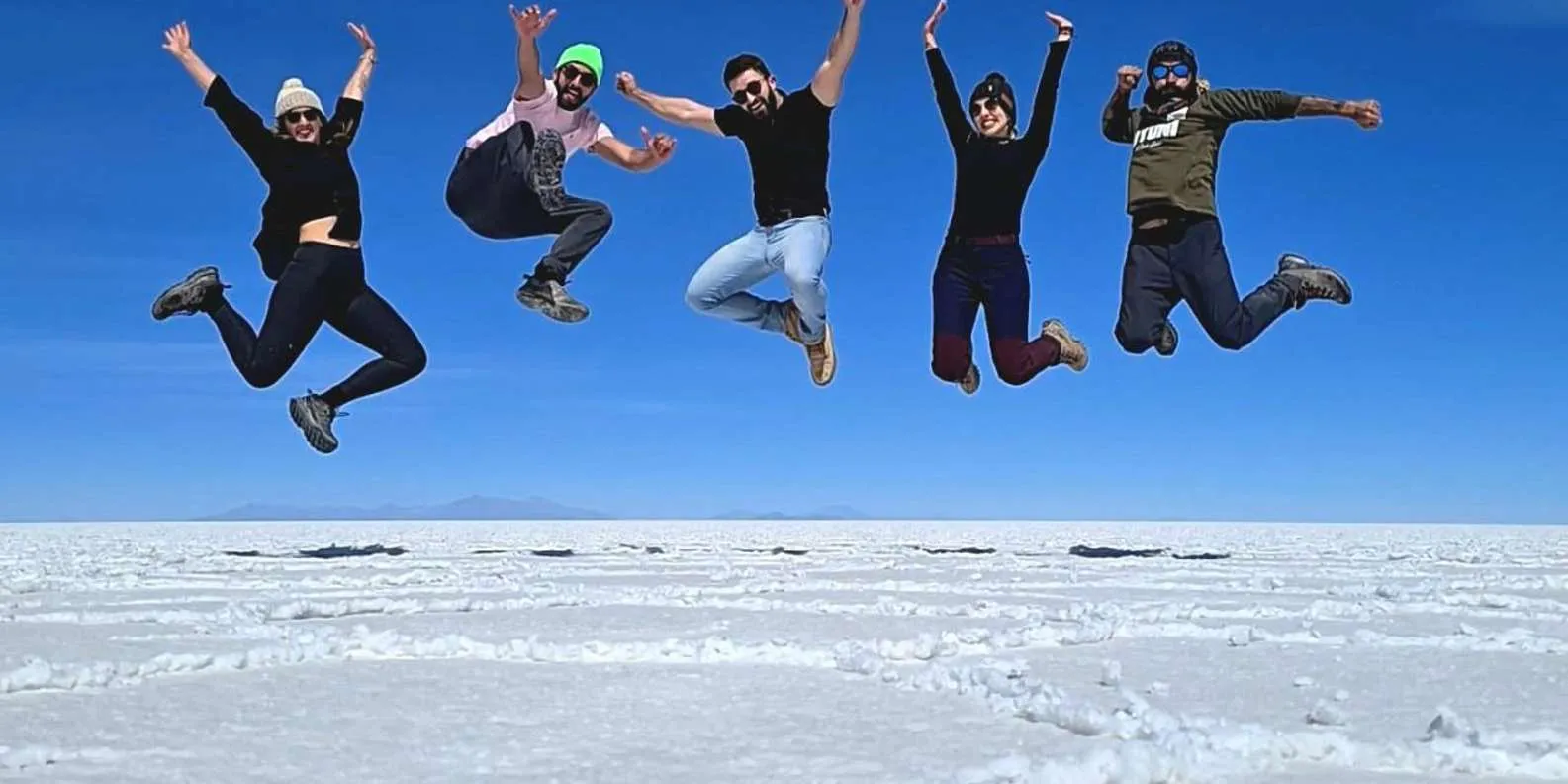
- Perspective photos: drivers are usually good at these. Bring props.
- Ojos del Salar, the Dakar monument, the Playa Blanca salt hotel and the Plaza de las Banderas: the standard cluster near the eastern edge of the salt flat.
- Colchani: a salt-processing village with handicraft stalls.
- Cementerio de Trenes (train cemetery): rusting locomotives just outside Uyuni.
- Arrival in Uyuni (about 3,660 m), around 15:00: the end time can slip because of weather, so book onward travel for the next day.
How the four days are used
Day one begins with the border journey and visits highland lagoons, the Dalí Desert area, thermal springs and the Sol de Mañana geothermal area, before an overnight in the Bolivian highlands. The advertised route approaches 5,000 metres: this is not a gentle first excursion after a sea-level flight. The altitude guide explains how to build up to it.
Day two continues through rock formations and lagoon landscapes towards a salt-hostel overnight. Expect substantial driving and basic infrastructure between stops.
Day three is the Salar de Uyuni day, with salt-flat photographs, a route including Incahuasi when accessible, and stops around Colchani and the train cemetery. The listing then describes travel back towards the highlands rather than finishing your booking in Uyuni. In practice this is the long day: the vehicle drives back south to a refuge such as Villa Mar.
Day four is the return to Hito Cajón and the minibus to San Pedro. Its advertised midday arrival is an estimate. Do not plan a tight international or domestic flight connection around it; if you are flying out, our Calama transfer guide covers the airport run.
Route and altitude table
| Day |
Stop |
Approx. altitude |
Notes |
| 1 |
San Pedro de Atacama |
About 2,400 m |
Pickup 06:00–07:30 |
| 1 |
Hito Cajón border |
About 4,480 m |
Chilean and Bolivian migration |
| 1 |
Laguna Blanca / Verde |
About 4,330 m |
Licancabur, about 5,920 m, behind |
| 1 |
Termas de Polques |
About 4,400 m |
Water around 29–30 °C |
| 1 |
Sol de Mañana |
About 4,900 m |
Highest point |
| 1 |
Laguna Colorada |
4,278 m |
Flamingos; about 60 km² |
| 1 |
Night 1 |
About 4,000–4,600 m |
Villa Mar, Huayllajara or a Siloli lodge |
| 2 |
Árbol de Piedra, Siloli |
About 4,500 m |
Lagoon route |
| 2 |
Lagunas Honda, Hedionda, Cañapa |
About 4,100–4,200 m |
Flamingos |
| 2 |
Ollagüe viewpoint |
Volcano about 5,870 m |
Lagoon route |
| 2 |
Night 2 (salt hotel) |
About 3,650–3,700 m |
Colcha K, Chuvica or San Juan |
| 3 |
Salar de Uyuni sunrise |
About 3,656 m |
|
| 3 |
Isla Incahuasi |
About 3,700 m |
Dry season only |
| 3 |
Colchani, train cemetery, Uyuni |
About 3,660 m |
Arrive around 15:00 |
Prices and what you will actually pay
| Option |
Where we found it |
What you get |
Best for |
| Shared 3-day one way |
Uyuni salt flat tour on Viator, from about US$412 (4.4/5, 46 reviews); also sold by San Pedro agencies |
Six-person 4x4, Spanish-speaking driver, basic lodging, meals |
Travellers continuing into Bolivia |
| Shared 4-day return |
4-Day Uyuni Salt Flats Tour, from about US$352 (4.5/5, 88 reviews) |
The same, plus the drive back to San Pedro on day four |
Travellers flying out of Calama |
| Comfort upgrades |
Private room on night 1; English-speaking driver (often priced per booking) |
Better sleep; commentary in English |
Couples, non-Spanish speakers |
| Private 4x4 |
Agencies in San Pedro and Uyuni |
Your own car and schedule, often better lodges |
Families, photographers, groups of four to six |
| Luxury or semi-private 2-day |
Specialist agencies |
Modern Land Cruiser, English guide, lunch on the salt |
Short on time, high budget |
| Public bus (no tour) |
Bus companies in San Pedro |
Transport only, via Ollagüe |
Speed and budget; you see none of the lagoons |
The scenery is the same at every price, so the standard shared tour is good value. If you add only one upgrade, make it the private room on night 1. That is the coldest, highest night, and a shared dorm at around 4,300 m is where many people’s trip goes wrong. Pay for an English-speaking driver only if your group will split the cost. Many drivers say little beyond place names, so you are not missing a full guided commentary.
Bolivian operators’ dollar quotes have moved a lot since the boliviano started floating. Ask for a written quote in the currency you will pay in.
What is and is not included
Transport, a driver, accommodation, meals and an oxygen bottle are listed. Bolivian national-park admission is excluded. Ask which overnight rooms are shared or private, whether bathrooms and showers are shared, and what bedding is supplied. “Accommodation included” says very little about comfort.
| Usually included |
Usually not included (cash, in bolivianos) |
| Hotel pickup in San Pedro (town centre) |
Eduardo Avaroa reserve entry |
| Minibus to the border; 4x4 in Bolivia (up to six people) |
Bolivian border charge |
| Spanish-speaking driver (not a guide) |
Isla Incahuasi entry |
| Two nights’ basic lodging (refuge and salt hotel) |
Termas de Polques entry |
| Meals from day one to day three |
Toilets, charged per use |
| Drop-off in central Uyuni |
Sleeping bag (rentable in San Pedro) |
|
Hot showers, Wi-Fi, heating, extra water, snacks |
|
Rubber boots in the rain (rentable) |
|
Tips for the driver |
The guiding language is Spanish in the current listing. A driver who handles the expedition is not automatically an English-speaking naturalist guide. If language matters, establish it before paying rather than assuming it will be similar to your San Pedro day tours.
How much cash to carry: ask your operator for the current list of fees and carry more than it adds up to, plus a US$50 note for emergencies. There are no ATMs between the border and Uyuni, and cards are not accepted on the route. Exchange houses in San Pedro sell bolivianos; ask for small notes.
Meals: expect simple food (soup, pasta, rice, chicken, sometimes llama, bread and tea). Tell the operator at booking if you are vegetarian, and bring snacks; our restaurant guide covers where to eat before you go.
Luggage: bags ride on the roof, and operators usually allow one medium bag each. A soft duffel or backpack is better than a hard suitcase.
How to choose an operator: a safety checklist
The landscapes are the same on every tour. What differs is the driver and the vehicle. Traveller reviews over the years have repeatedly reported drunk or exhausted drivers, serious crashes, and travellers left at the border without their onward bus tickets. Some cheap Uyuni-based agencies sell seats and then hand you to a subcontracted driver.
Ask these questions before you pay:
- Does the company run its own vehicles and drivers, or subcontract? Ask for the driver’s name and the car’s year.
- Is there a seatbelt for every seat? Ask, and check when you get in.
- What is the alcohol policy? Ask whether there is a written zero-tolerance rule and what happens if you report a driver.
- Is there a satellite phone or radio, a first-aid kit and oxygen in the vehicle? Better operators carry all three.
- Which fees are excluded? Get the list in writing: reserve, Incahuasi, Polques and the border charge.
- Where is the night-1 lodging, at what altitude, and is a private room available?
- What happens if Hito Cajón closes? Ask about rebooking, refunds or a reroute via Ollagüe.
- What are the cancellation terms?
- What do the last three to six months of reviews say? Search Tripadvisor and Google reviews for “drunk”, “borracho”, “accident” and “border”.
- How is payment taken? A deposit online with the balance before departure is normal. Never pay the whole amount in cash to a street tout.
On the trip: if your driver drinks, refuse to get in, call the office (save the number before you leave) and ask the other passengers to back you. Operators can send a replacement vehicle.
Our picks by traveller type
These picks come from consistent recent reviews and published itineraries, not from site visits. Reputations change, so read reviews from the last few months before booking.
- A shared tour from San Pedro: the agencies travellers most often shortlist are Estrella del Sur, Cordillera Traveller and World White Travel, which reviewers describe as similar in itinerary and price, all run in Spanish. Online, the Uyuni Adventure tour on Viator lets you pick the endpoint, room type and driver language in one booking.
- Returning to Chile: the 4-Day Uyuni Salt Flats Tour on GetYourGuide, with accommodation and all main meals listed and a Spanish-speaking driver.
- Non-Spanish speakers: any shared tour with an English-speaking driver added, or a private tour with an English-speaking guide.
- Families and photographers: a private 4x4, so you control the timing at Laguna Colorada and the salt-flat sunrise.
- A splurge: Kachi Lodge, six heated geodesic domes on the northern salt flat at the foot of Tunupa volcano. It sells full-board stays with a minimum of two nights and works best with a private transfer.
- If you just need to get to Uyuni: the direct bus (see the alternatives below).
Booking direct or through a platform: a San Pedro office lets you meet the people and inspect the sleeping bags, and its prices are often lowest. GetYourGuide and Viator add written cancellation terms and a way to complain if things go wrong, at a higher price. Avoid buying the cheapest seat you can find on arrival in Uyuni.
Altitude deserves its own decision
This itinerary includes highland sleeping as well as day visits. That is different from returning to San Pedro after Piedras Rojas or El Tatio. Take time to acclimatise, discuss relevant health conditions with a clinician and read the altitude guide before booking.
San Pedro to Uyuni is the harder direction. You climb from about 2,400 m to about 4,480 m at the border within roughly an hour, then to about 4,900 m at Sol de Mañana, and spend the first night at roughly 4,000–4,600 m. That breaks the usual climb-high, sleep-low rule. Coming from Uyuni (about 3,656 m), you have already slept two nights high before you reach the geysers.
|
Day 1 |
Night 1 |
Day 2 |
Night 2 |
Day 3 |
| San Pedro to Uyuni |
2,400 m up to about 4,900 m |
About 4,000–4,600 m |
4,100–4,500 m |
About 3,650 m |
About 3,656 m |
| Uyuni to San Pedro |
About 3,656 m |
About 3,650 m |
4,100–4,500 m |
About 4,300 m |
About 4,900 m, down to 2,400 m |
How to prepare:
- Spend two or three nights in San Pedro first and take at least one high excursion, such as the El Tatio geysers at about 4,300 m, before the crossing. Our four-day itinerary shows how to order the days.
- Drink plenty of water, skip alcohol the night before and on night 1, and eat light.
- Acetazolamide helps many people, but take it only on medical advice.
- Know the warning signs: a headache that does not improve, vomiting, confusion, loss of coordination or breathlessness at rest. If any appear, tell the driver and descend. Ask whether your vehicle carries oxygen.
An oxygen bottle in the vehicle does not make a rapid ascent risk-free. Ask how the operator handles illness, route changes and evacuation. Check that any insurance you choose covers the actual activities, altitude and countries involved.
Border documents and cash
Entry requirements depend on nationality and can change. Use official Chilean and Bolivian immigration or consular information for your passport, then confirm the operator’s document and border instructions. Do not treat another traveller’s visa experience as your own requirement.
| Nationality |
Tourist visa? |
Notes |
| United States |
No, since 1 December 2025 |
Up to 90 days a year; passport valid for six months or more |
| Israel, South Korea, South Africa and some other countries |
No, under the same December 2025 change |
Bolivia called the rollout gradual, so confirm before travel |
| UK, EU and Schengen, Canada, Australia, New Zealand, Japan |
No |
Entry stamp on arrival |
| Most of South America |
No |
A national ID card is often accepted |
| Other nationalities |
Possibly |
Check with a Bolivian consulate before you reach Hito Cajón |
Everyone also needs to:
- Complete SIGEMIG, Bolivia’s free online migration pre-registration, before you arrive, and save the QR code. If you skip it, immigration registers you at the border, but you can be fined when you leave Bolivia. Use your night-2 salt hotel or your Uyuni hotel as the address.
- Get your entry stamp at Hito Cajón. Overland travellers who leave without one have trouble when they exit.
Yellow fever: the vaccine is not required for this route if you arrive from Chile and have not recently been in a risk country such as Peru, Brazil or Colombia. The US CDC does not recommend it for travel limited to areas above 2,300 m. It is relevant if you go on to Bolivia’s Amazon lowlands. Some operator pages still describe the old visa and vaccine rules for US citizens; those rules no longer apply.
Ask which payments need Bolivian cash, what the current reserve charges are, and where you can obtain money before leaving. Carry the water, warm clothing and personal supplies requested by the supplier; remote overnight stops do not provide the same services as central San Pedro.
Bolivia in 2026: money, fuel, politics and border closures
Money. Bolivia ended its fixed exchange rate of 6.96 bolivianos to the US dollar at the end of June 2026. The Banco Central de Bolivia’s official rate was about Bs 12 to the dollar in late October 2026. On your trip, that means:
- Many dollar prices online were worked out at the old rate and are out of date. Fees set in bolivianos now cost less in dollars than they did.
- Exchange houses in San Pedro and Uyuni are fine to use. Bring clean US dollar notes as a backup.
- Check the Banco Central de Bolivia’s daily rate in the week you travel.
Fuel. Bolivia has had diesel shortages through 2026, and long-distance bus services have been cut at times. Operators with their own fleets have generally kept running. The buses out of Uyuni are the weak link, so build in a buffer day.
Politics. Road blockades during protests have disrupted travel in Bolivia in 2026. Tourist areas, including Uyuni, have kept operating, and tours on the salt flat are rarely affected once you are out of the cities. Read the UK, Canadian or your own government’s travel advice before you go.
Border closures at Hito Cajón. Snow and viento blanco (whiteout winds) close the pass every winter. In 2026 it shut on 9 June, was listed as not open on 11 August, closed again on 21–22 August and was still closed on the Bolivian side for snow clearing on 20 September, according to local Chilean news reports and the El Loa provincial delegation. Closures can last days.
- What to do: avoid a tight connection in Uyuni, especially from June to September. Ask your operator about its closure policy, and check the official Chilean border-status page (pasosfronterizos.gov.cl) the day before you leave.
Border hours and time zones. The Chilean post lists opening hours from about 08:00 to 18:00 or 20:00 Chilean time, and hours shrink in bad weather. While Chile is on summer time, from early September to early April, San Pedro is one hour ahead of Bolivia; for the rest of the year the two share the same time. Expect your driver’s watch and your phone to disagree.
Rainy-season expectations
Water on the salt flat can create reflections, but it can also alter roads and access to places such as Incahuasi. A “mirror effect” photograph is not a promise for every date, and a dry-season itinerary may be changed when water levels rise. Ask what route substitutions apply rather than buying on a single image.
|
Wet season (January to March or April) |
Dry season (May to November) |
| The salt flat |
Mirror effect when it is flooded, mainly January–February, sometimes into March |
Bright white hexagonal crust to the horizon |
| Isla Incahuasi |
Often unreachable |
Open |
| Route changes |
Night 2 may move to Uyuni; some tracks close; rubber boots needed |
Full itinerary |
| Temperatures |
Milder nights |
Very cold nights, far below freezing from June to September |
| Border risk |
Storms possible |
Snow closures most likely June–September |
| Crowds |
Busy around Christmas, New Year and Carnival |
Busiest in July and August |
Best overall: April–May and September–November, with milder nights, less snow risk and the full route. For the mirror, go from late January to March and accept a shorter itinerary. Our best time to visit guide covers the Chilean side.
For a short Chile-only stay, multi-day Atacama packages are the simpler comparison. Add Uyuni because you want the expedition and have time for it, not because the salt-flat name appears beside other San Pedro tours.
Packing list
Essentials
- Passport with six months’ validity or more, and a printed and saved SIGEMIG QR code
- Bolivianos in small notes, plus a US$50 backup
- A sleeping bag rated to −10 to −15 °C (essential from June to August; rentable in San Pedro) and a liner
- Down jacket, thermal base layers, fleece, hat, gloves and a neck tube
- Sunglasses, SPF 50 and lip balm; the UV is intense above 4,000 m
- Swimsuit and quick-dry towel for Polques
- At least a litre of water a day, plus a refillable bottle
- Headlamp, a power bank (charging is limited and unreliable) and a plug adapter
Comfort and hygiene
- Toilet paper, wet wipes and hand sanitiser
- Snacks such as nuts and chocolate. Coca sweets are sold in Bolivia; do not bring coca back into Chile, where SAG confiscates it
- Hand and foot warmers
- Altitude medication (as your doctor advises), painkillers and rehydration salts
- A soft duffel bag (it rides on the roof)
For fun
- Props for perspective photos (a toy dinosaur, a wine bottle, a crisps tube)
- Rubber boots or sandals for wet-season salt water (rentable)
Onward from Uyuni
| To |
How |
Time |
Notes |
| La Paz |
Flight with Boliviana de Aviación (BoA) |
About 1 h |
The fastest option; check the current timetable |
| La Paz |
Overnight tourist bus |
10–12 h |
Fewer departures during the diesel shortage |
| Oruro, then bus to La Paz |
Train: Expreso del Sur or Wara Wara del Sur, a few nights a week, leaving after midnight |
About 7 h |
Check Ferroviaria Andina’s timetable |
| Potosí / Sucre |
Bus |
4–7 h |
Paved roads |
| Tupiza / Villazón (Argentina) |
Expreso del Sur train |
About 8 h |
For onward travel into Argentina |
| San Pedro de Atacama |
Direct bus via Ollagüe, leaving early morning |
About 12 h |
Or take a three-day reverse tour |
Do not book a flight or bus on the same afternoon your tour ends. Arrivals in Uyuni around 15:00 often slip.
Doing it in reverse: Uyuni to San Pedro de Atacama
This is the easier direction for altitude, and it is how most Bolivia-first travellers do it.
- Day 1 (from about 10:30): the train cemetery, Colchani, the salt flat (flags, Dakar monument, Incahuasi in the dry season) and sunset on the salt. Salt hotel at about 3,650 m.
- Day 2: the San Juan and Alota area, the Ollagüe viewpoint, the high lagoons, Árbol de Piedra and Laguna Colorada. Refuge at about 4,300 m.
- Day 3 (wake-up around 04:30–05:00): Sol de Mañana at dawn, a soak at Polques, Laguna Verde, then Hito Cajón and a minibus to San Pedro, arriving between late morning and early afternoon.
- Border-day checklist: get your Bolivian exit stamp (keep SIGEMIG in order to avoid the fine), then Chilean entry with the PDI. Chile’s SAG agricultural inspection checks for fresh fruit, vegetables, meat, dairy, seeds and coca leaves, which are illegal in Chile. Declare anything doubtful, because the fines are steep.
- Confirm your transfer. Make sure the price includes the Chilean minibus from the border to San Pedro. Some Uyuni tours charge it separately or collect it at the border.
Once you arrive, see where to stay in San Pedro, things to do in San Pedro and our Valle de la Luna guide, and book a stargazing tour for your first clear night.
Alternatives to the three-day tour
| Alternative |
Who it suits |
Trade-off |
| Fly to Uyuni and take a one-day tour, such as the Day Trip to Uyuni Salt Flats on Viator (from about US$130, 4.2/5 from 603 reviews) |
Short on time; only want the salt flat |
You miss the lagoons, geysers and flamingos |
| The Tupiza to Uyuni four-day route |
Coming from Argentina; want fewer crowds and red-rock canyons |
Longer, and it starts in southern Bolivia |
| Private or luxury, such as Kachi Lodge or a private 4x4 with an English-speaking guide |
Comfort-first travellers |
Many times the price of a shared seat |
| The direct bus from San Pedro to Uyuni |
Pure transport, on a budget |
It crosses at Ollagüe, not through the reserve, so you skip the highlights |
| Atacama day trips only |
No Bolivia this time |
See our San Pedro tours compared |
Common complaints and how to avoid them
| Complaint |
Prevention |
| Drunk or reckless driver |
Use the checklist above, check recent reviews, refuse to ride and call the office |
| Freezing night 1 |
Bring or rent a −10 °C bag, pay for a private room and sleep in a hat |
| Running out of cash |
Carry more bolivianos than the fee list adds up to, plus US$50; there are no ATMs after the border |
| Surprise fees |
Get the exclusions in writing before you pay |
| Moved into another company’s car |
Normal in the industry; insist the vehicle meets your operator’s standards |
| Stranded by a border closure |
Book flexible onward travel and ask about the closure policy |
| Bland food |
Pack snacks and flag dietary needs at booking |
| Missed Incahuasi in the wet season |
Expect it, and choose the dry season if it matters to you |
| Missing onward bus tickets at the border (reverse direction) |
Get the tickets or vouchers in hand before day 3 |